Your Ad Here
Showing posts with label challenge to non -Muslims. Show all posts

Thursday, June 4, 2009

Obama calls for new beginning between US, Muslims


Join 4Shared Now!
Join 4Shared Now!


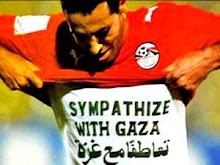
No one for us or Gaza except for Allah


CAIRO – Quoting from the Quran for emphasis, President Barack Obama called for a "new beginning between the United States and Muslims" Thursday and said together, they could confront violent extremism across the globe and advance the timeless search for peace in the Middle East.
"This cycle of suspicion and discord must end," Obama said in a widely anticipated speech in one of the world's largest Muslim countries, an address designed to reframe relations after the terrorist attacks of Sept. 11, 2001, and the U.S.-led war in Iraq.
The White House said Obama's speech contained no new policy proposals on the Middle East. He said American ties with Israel are unbreakable, yet issued a firm, evenhanded call to the Jewish state and Palestinians alike to live up to their international obligations.
In a gesture to the Islamic world, Obama conceded at the beginning of his remarks that tension "has been fed by colonialism that denied rights and opportunities to many Muslims, and a Cold War in which Muslim-majority countries were often treated as proxies without regard to their own aspirations."
"And I consider it part of my responsibility as president of the United States to fight against negative stereotypes of Islam wherever they appear," said the president, who recalled hearing prayer calls of "azaan" at dawn and dusk while living in Indonesia as a boy.
At the same time, he said the same principle must apply in reverse. "Just as Muslims do not fit a crude stereotype, America is not the crude stereotype of a self-interested empire."
Obama's remarks were televised on all radio and television stations in Israel, and with Arabic voice-over translations by Arab satellite stations Al-Arabiya and Al-Jazeera, Egyptian TV and Al-Manar, an outlet for the militant group Hezbollah. The speech was not broadcast in Iran, where the goverment jammed signals to block satellite owners from watching.
The president drew a somewhat positive response from corners of the world not given to complimenting the United States.
"There is a change between the speech of President Obama and previous speeches made by George Bush," said Fawzi Barhoum, a Hamas spokesman in Gaza. But he complained that Obama did not specifically note the suffering in Gaza following the three-week Israeli incursion earlier this year and did not apologize for U.S. military attacks in Iraq and Afghanistan.
In Iran, Mohammad Ali Abtahi, a cleric who was vice president under reformist President Mohammad Khatami, called the speech "compensation to hostile environment which was created during President Bush."
"This can be an initial step for removing misconceptions between world of Islam and the West," he said.
Obama spoke at Cairo University after meeting with Egyptian President Hosni Mubarak on the second stop of a four-nation trip to the Middle East and Europe.
The speech was the centerpiece of his journey, and while its tone was striking, the president also covered the Middle East peace process, Iran, the wars in Afghanistan and Iraq and the violent struggle waged by al-Qaida.
Obama arrived in the Middle East on Wednesday, greeted by a new and threatening message from al-Qaida's leader, Osama bin Laden. In an audio recording, the terrorist leader said the president inflamed the Muslim world by ordering Pakistan to crack down on militants in the Swat Valley and block Islamic law there.
But Obama said the actions of violent extremist Muslims are "irreconcilable with the rights of human beings," and quoted the Quran to make his point: "be conscious of God and always speak the truth ..."
"Islam is not part of the problem in combatting violent extremism — it is an important part of promoting peace," he said.
"Hamas must put an end to violence, recognize past agreements, and recognize Israel's right to exist," he said of the organization the United States deems as terrorist.
"The Palestinian Authority must develop its capacity to govern, with institutions that serve the needs of its people," Obama said.
"At the same time, Israelis must acknowledge that just as Israel's right to exist cannot be denied, neither can Palestine. The United States does not accept the legitimacy of continued Israeli settlements" on the West Bank and outskirts of Jerusalem, he said. "It is time for these settlements to stop."
As for Jerusalem itself, he said it should be a "secure and lasting home for Jews and Christians and Muslims ..."
Obama also said the Arab nations should no longer use the conflict with Israel to distract their own people from other problems.
He treaded lightly on one issue that President George W. Bush had made a centerpiece of his second term — the spread of democracy.
Obama said he has a commitment to governments "that reflect the will of the people." And yet, he said, "No system of government can or should be imposed upon one nation by any other."
At times, there was an echo of Obama's campaign mantra of change in his remarks, and he said many are afraid it cannot occur.
"There is so much fear, so much mistrust. But if we choose to be bound by the past, we will never move forward," he said.
The president's brief stay in Cairo included a visit to the Sultan Hassan mosque, a 600-year-old center of Islamic worship and study. He also toured the Great Pyramids of Giza, and joked with reporters that if they were not present, "I'd get on a camel." Some of his aides did just that.
The build-up to the speech was enormous, stoked by the White House although Obama seemed at pains to minimize hopes for immediate consequences.
"One speech is not going to solve all the problems in the Middle East," he told a French interviewer. "Expectations should be somewhat modest."
Eager to spread the president's message as widely as possible, the tech-savvy White House orchestrated a live Webcast of the speech on the White House site; remarks translated into 13 languages; a special State Department site where users could sign up for speech highlights; and distribution of excerpts to social networking giants MySpace, Twitter and Facebook.
Though the speech was co-sponsored by al-Azhar University, which has taught science and Quranic scripture here for nearly a millennium, the actual venue was the more modern and secular Cairo University.
Red draperies formed a backdrop for the speech, blocking view of a portrait of Mubarak, an aging autocrat who's ruled Egypt since 1981.

Source

The Whit House

Thursday, December 18, 2008

P 2 The Amazing Qur'an,by Gary Miller,The Revelation,The challenge to non -Muslims,Youtube video


Join 4Shared Now!
Join 4Shared Now!


Your Ad Here


P 2 The Amazing Qur'an
by Gary Miller

The Revelation


It is common knowledge that Muhammad had a very difficult life. All of his daughters died before him except one, and he had a wife of several years who was dear and important to him, who not only  preceded him in death at a very critical period of his life. As a matter of fact, she must have been quite a woman because when the first revelation came to him, he ran home to her afraid. Certainly, even today one would have a hard time trying to find an Arab who would tell you, "I was so afraid that I ran home to my wife." They just aren't that way. Yet Muhammad felt comfortable enough with  his wife to be able to do that. That's how influential and strong woman she was. Although these examples are only a few of the subjects that would have been on Muhammad's mind, they are sufficient in intensity to prove my point. The Qur'an does not mention  any of these things - not the death of his children, not the death of his beloved companion and wife, not his fear of the initial revelations, which he so beautifully shared with his wife  - nothing; yet, these topics must have hurt him, bothered him, and  caused him pain and grief during periods of his psychological reflections, then these subjects, as well as others, would be prevalent or at least mentioned throughout. A truly scientific approach to the Qur'an is possible because the Qur'an offers something that is not offered by other religious scriptures, in particular, and other religions, in general. It is what scientists demand. Today there are many people who have ideas and theories about how the universe works. These people are all over the place, bu t the scientific community does not even bother to listen to them. This is because within the last century the scientific community has demanded a test of falsification. They say, "If you have theory, do not bother us with it unless you bring with that theory a way for us to prove whether you are wrong or not."
Such a test was exactly why the scientific community listened to Einstein towards the beginning of the  century. He came with a new theory and said, "I believe the universe works like this; and here are three ways to prove whether I am wrong!"  So the scientific community subjected his theory to the t ests, and within six years it passed all three. Of course, this does not prove that he was great, but it proves that he deserved to be listened to because he said, "This is my idea; and if you want to try to prove me wrong, do this or try that." This is exactly what the Qur'an has  - falsification tests. Some are old (in that they have already been proven true), and some still exist today. Basically it states, "If this book is not what it claims to be, then all you have to do is this or this or this to prove that it is false." Of course, in 1400 years no one has been able to do "This or this or this," and thus it is still considered true and authentic. I suggest to you that the next time you get into dispute with someone about Islam and he claims that he has the truth and that you are in darkness, you leave all other arguments at first and make this suggestion. Ask him, "Is there any falsification test in your religion? Is there anything in your religion that would prove you are wrong if I could prove to you that it exists  - anything?" Well, I can promise right now that people will not have anything  - no test, no proof, nothing! This is because they do not carry around the idea that they should not only present what they believe but should also offer others a chance to prove they're wrong. However, Islam does that. A perfect example of how Islam provides man with a chance to verify its authenticity and "prove i t wrong" occurs in the 4th chapter. And quiet honestly, I was surprised when I first discovered this challenge. It states:
"Do they not consider the Qur'an? Had it been from any other than Allah, they would surely have found therein much discrepancy."


The challenge to non -Muslims
This is a clear challenge to the non -Muslim. Basically, it invites him to find a mistake.As a matter of fact, the seriousness and difficulty of the challenge aside, the actual presentation of such a challenge in the first place is not even in human nature and is inconsistent with man's personality. One doesn't take an exam in school after finishing the exam; write a note to the instructor at the end saying, "This exam is perfect. There are no mistakes in it. Find one if you can!" One just doesn't do that. The teacher would not sleep until he found a mistake! And yet this is the way the Qur'an approaches people. Another interesting attitude that exists in the Qur'an repeatedly deals with its advice to the reader. The Qur'an informs that reader about different facts and then gives the advice: "If you want to know more about this or that, or if you doubt what is said, then you should ask those who have knowledge." This too is a surprising attitude. It is not usual to have a book that comes from someone without training in geography, botany, biology, etc., who discusses these subjects and then advises the reader to ask men of knowledge if he doubts anything.
Yet in every age there have been Muslims who have followed the advice of the Qur'an and made surprising discoveries. If one looks to the works of Muslim scientists in many centuries ago, one will find them full of quotations from the Qur'an. These works state that they did research in such a place, looking for something. And they affirm that the reason they looked in such and such a place was that the Qur'an pointed them in that direction. For example, the Qur'an mentions man's origin and then tells the reader, "Research it!" It gives the reader a hint where to look and then states that one should find out more about it. This is the kind of thing that Muslims today largely seem to overlook -but not always, as illustrated in the following example. A few years ago, a group of men in Riyadh, Saudi Arabia collected all if the verses  in the Qur'an which discuss embryology - the growth of the human being in the womb. They said, "Here is what the Qur'an says. Is it the truth?" In essence, they took the advice of the Qur'an: "Ask the men who know." They chose, as it happened, a non -Muslim who is a professor of embryology at the University of Toronto. His name is Keith  Moore, and he is the author of textbooks on embryology  - a world expert on the subject. They invited him to Riyadh and said, "This is what the Qur'an says about your subject. Is it true? What can you tell us?" While he was in Riyadh, they gave him all of the help that he needed in translation and all of the cooperation for which   he asked. And he was so surprised at what he found that he changed his textbooks. In fact, in the second edition of one of his books, called before we are born... in the second edition about the history of  embryology, he included some material that was not in the first edition because of what he found in the Qur'an. Truly this illustrates that the Qur'an was ahead of its time and that those who believe in the Qur'an know what other people do not know.

Teach All Over The World- Good Jobs